



I’m often asked what I consider to be the single best “bang for your buck” exercise for developing the shoulders. Although some instructors would say there is no such thing as a stupid question, the fact is that anyone asking this particular question obviously doesn’t know much about the anatomy of the shoulders.
The shoulder (glenohumeral) joint has a ball-and-socket design that allows for a wide range of movement. For you exercise science majors, the major movements of the shoulder are abduction, flexion, horizontal adduction, internal rotation, extension, horizontal abduction and external rotation. Starting to see the problem here?
Most bodybuilding articles describe the deltoid anatomy as having three portions: anterior (front), medial (side) and posterior (rear). In fact, there are actually seven portions, more appropriately described as “deltoids 1-7, anterior to posterior.” And the percentage of activation of each portion depends upon the orientation of the upper arm to the shoulder joint.
Now let’s look at how to apply some of this information to program design. Because of their unique function and anatomy, regardless of the exercise performed, the shoulder muscles are never uniformly activated and thus require a variety of exercises for complete development. For example, deltoids 1 and 7 are respectively stimulated most by pressing and pulling exercises, and I’ve found that deltoids 3-5 require the most direct work. Further, it’s important to use a wide variety of exercises in your shoulder training to ensure structural balance that will keep the joint healthy. In that regard, I prefer a ratio of 2:1 of dumbbell to barbell work.
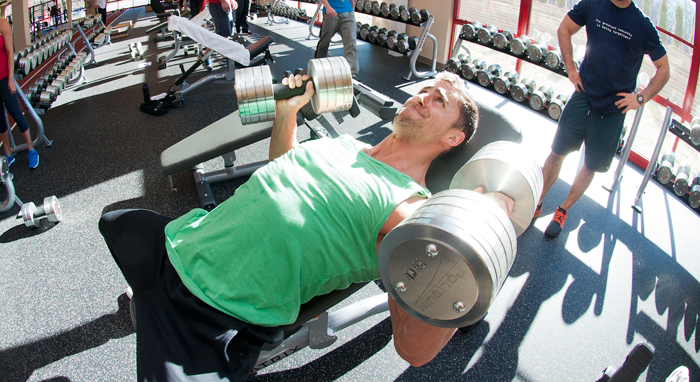
One way to ensure sufficient variety in your shoulder training is to use tri-sets, which involve performing three exercises in sequence as part of one entire set. One effective tri-set to help you build shoulders like boulders is to perform a set of dumbbell presses with a semi-supinated grip, followed immediately by a lateral raise and then a bent-over lateral raise (chest on knees, arms forward). Perform 12 reps of each exercise, with no rest between the second and third exercises, and incorporate a 20 percent drop in weight for each exercise. Rest 180 seconds between tri-sets, completing a total of three sets – believe me, it’s a lot tougher than it looks on paper. And because the rest time between the first and second exercises must be minimal (no more than 10 seconds), you need to have your dumbbells set up before you start.
Regarding the use bands for isolation work, the problem is that you get maximum effect only at the end of the motion (when the band is stretched), and as such this creates an imbalance in the strength curve. Also, bands may increase the risk of shoulder injuries as they disrupt the biomechanics of the shoulder.
When I was asked to work with both the Canadian National Synchronized Swimming Team and the Canadian Swimming Team many years ago, I found there was an epidemic of shoulder problems among these athletes. Upon investigation, I learned that the resistance training for the upper body consisted of work with surgical tubing exercises – and when I had the athletes stop using these exercises, their shoulder problems quickly disappeared. It was that easy. The problem was that the tubing had adversely affected the athletes’ shoulder movement patterns during swimming. Specifically, during the tubing exercises the arms were decelerated by the tubing so that when these athletes swam, the muscles used to decelerate the shoulders did not function properly, causing increased stress on the joint.
Bottom line: Anyone who is looking for the one-and-only best shoulder exercise is headed for disappointment; the shoulders require a variety of exercises to ensure complete development. But if you intelligently apply the information in this article, you will be surprised just how quickly your shoulders will grow.
Copyright ©2011