




Blog

Poliquin Live

Tip 267: Get More Powerful: Vary Training Tempo With Inter-Repetition Rest

Jan 26


1/26/2012 8:47 AM  RssIcon

Get more powerful and produce more force by using inter-repetition rest periods. You’ll be able to lift heavier loads more powerfully, and your performance will benefit from the extra speed and weight lifted.It’s well known that the development of power and strength is greatest when training at the intensity at which power is maximized, meaning any way of improving recovery and minimizing fatigue is ideal for making training gains.

Often called cluster training, inter-repetition training is when you introduce a rest interval after every repetition or after a certain number of repetitions within a set. It allows you to increase the amount of weight lifted in the set and maintain more power as you progress through the workout because of the short recovery periods—you avoid the slowing of movement speed (or repetition power) as fatigue increases.

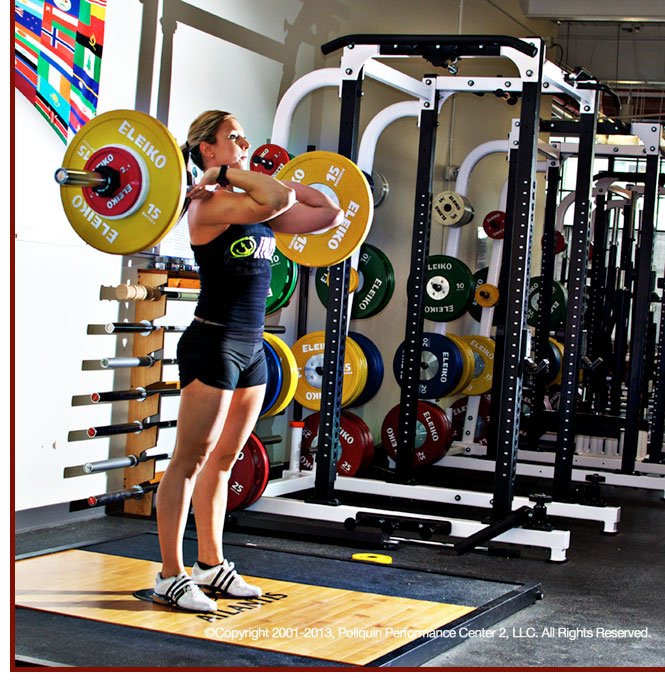
Typically, cluster training works like this: if you can normally power clean 200 pounds for one repetition and 180 pounds for three reps, try resting fifteen seconds between single reps by pausing with the barbell on the floor between reps (not in the top position). You may be able to clean 185 pounds for three single reps, maybe even 190 pounds. The result is you are performing the same number of reps, but the intensity is greater—and likely the power output too. Plus, you will be training more of the higher-threshold motor units.

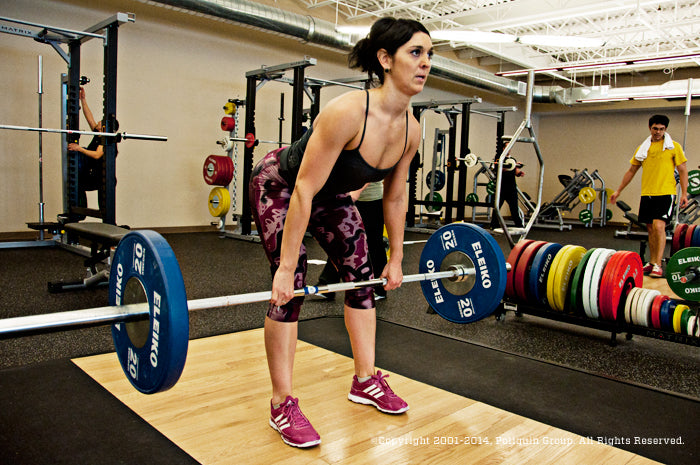
A new study in the Journal of Strength and Conditioning Research is the first to test the effect of inter-repetition rest during multiple sets of the power clean. This study compared peak power output, force, and velocity in the power clean with no inter-repetition rest, or with either  20 or 40 seconds of rest. Participants were trained college-aged men, and they performed three sets of six reps of the power clean at 80 percent of the 1RM. After each rep in the “no rest” group, participants returned the barbell to the floor in a controlled manner and immediately performed the next rep. In the “rest” groups they rested for 20 or 40 seconds in the start position of the power clean after they had returned the barbell to the floor.

Results showed that peak power significantly decreased by 16 percent during the “no rest” sets (as in there was a 16 percent drop in peak power from the first to the sixth rep of the set) compared to a decrease of 5.5 percent in the 20-second rest sets and only a drop of 3 percent in the 40-second rest sets.Peak force also decreased significantly in the “no rest” sets whereas participants maintained peak force throughout the set in the other two rest group. Peak velocity of the bar also decreased significantly by 10 percent in the “no rest” group and only dropped by 3.8 percent and 1.7 percent in the 20-second and 40-second rest groups, respectively.

Researchers suggest that the short recovery between reps in the two inter-repetition rest models allowed for recovery of short-term energy substrates such as phosphocreatine. The 20 to 40 second rest allowed for participants to almost completely resynthesize creatine and recover from the fatigue of the repetition. The results of this study confirm previous evidence that creatine is resynthesized in about 22 seconds.

Previous studies support mixing up training protocols with inter-repetition rest. Another study of elite Australian rugby players found that using inter-repetition rest  improves lower body power and velocity when training the power clean and squat. This study indicated that cluster training can lead to greater neural adaptations and the recruitment of more type 2 muscle fibers.

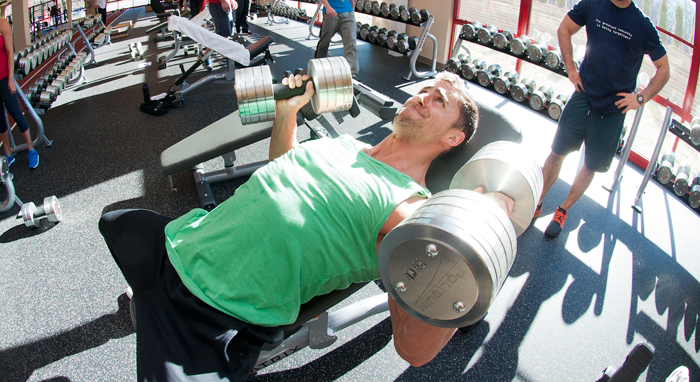
A 2010 study of cluster training for the upper body found that this method allowed participants to perform a high number of repetitions, while maintaining velocity of the lifting motion, even when fatigue would have become a factor in a traditional training scheme. Researchers note that cluster training is effective for developing power and speed for sports and should be programmed accordingly: upper body cluster training can be used in sports such as wrestling, boxing, or judo, while lower body power may be enhanced for rugby, soccer, or football, or track and field throwing events.
 
References:

Hansen, K., Cronin, J., Pickering, S., Newton, M. Does Cluster Loading Enhance Lower Body Power Development in Preseason Preparation of Elite Rugby Union Players? Journal of Strength and Conditioning Research. 2011. 25(8), 2118-2126.

Iglesias, E., Boullosa, D., Dopico, X., Carballeira, E. Analysis of Factors that Influence the Maximum Number of Repetitions in Two Upper-Body Resistance Exercises: Curl Biceps and Bench Press. Journal of Strength and Conditioning Research. 2010. 24(6), 1566-1572.
 
Hardee, J., Triplett, N., et al. Effect of Inter-Repetition Rest on Power Output in the Power Clean. Journal of Strength and Conditioning Research. 2012. Published Ahead of Print.

Copyright ©2012


< Back to Blog
Tags:

Your name:
Gravatar Preview
Your email:
Your website:
Title:
Comment:
Security Code
Enter the code shown above in the box below
Add Comment   Cancel 
Join Our Email List Follow us on Twitter Follow us on Facebook Follow us on YouTube