



During the past fours decades the focus in bodybuilding magazines has been on developing the chest, back and arms. In the strength and conditioning community, the focus has been on increasing pulling power with Olympic lifting variations and also on developing stability and trunk strength with so-called “core” exercise. But not so very long ago, wide shoulders were a primary goal for bodybuilding, and overhead pressing exercises formed the foundation of strength athletes. So, how about we go “Back to the Future” with this article and get everyone back on track with shoulder training.
Because of the relatively recent neglect of shoulder training, I’ve found many misconceptions exist among bodybuilders and strength coaches when it comes to developing shoulder strength. To set everyone straight, here are my top five little-known facts about training presses:
1. The ability to do the press-behind-neck with proper technique is a sign of healthy shoulders.

I agree with my colleague strength coach Bill Starr that, without question, the main cause of most shoulder problems in strength trained athletes is the lack of overhead pressing work. Until the mid-seventies, overhead pressing exercises were popular among the Iron Game practitioners. In fact, Bill Pearl, who won the 1971 NABBA Pro Mr. Universe at age 41 by beating out former Mr. Olympia Sergio Oliva and future Mr. Olympia Frank Zane, could perform a seated press-behind-the-neck with 310 pounds. But then came the era of weight training machines such as Nautilus – strength and conditioning coaches quickly lost interest in the overhead press when the Olympic press was dropped from competition in 1972.
Of course, one could argue that one predictor of shoulder health is the strength of the muscles that externally rotate the shoulders, which is true. But overhead pressing strength, or lack of it, is a better predictor. Nick Liatsos, a Boston-based physical therapist and PICP coach who treats many professional athletes, has made the same observation. Liatsos is also of the opinion that one should be able to able to press-behind-neck to demonstrate healthy shoulder function and that the strength ratio of the
press-behind-neck to the bench press is a predictor of shoulder health.
When we perform upper-extremity structural balance testing as outlined in the Level 1 PICP practical course, we can identify a strong correlation between shoulder pain and lack of overhead strength. There are two ratios of interest that can point that out:
Ratio 1. The ratio between seated dumbbell overhead presses and the bench press. The weight that can be lifted for 8 reps on each dumbbell on an overhead press should represent 29 percent of the close-grip bench press measure. In other words, a man who can close-grip bench press 100 kilos for a single would use a pair of 29-kilo dumbbells for 8 reps in the seated dumbbell overhead press. Failure to meet that ratio indicates poor stabilization of the scapulae, mainly due to weakness of the serratus anterior.
Ratio 2. The ratio between the press-behind-neck and the bench press. The weight for a 1RM (repetition maximum) press-behind-neck from a seated position should represent 66 percent of the weight used for 1RM in the close-grip bench press. That exercise is performed from a dead-stop position with the bar resting on the traps, not from a weight handed off to the trainee in the lock-out position. If one cannot do the press-behind-neck pain free, soft tissue limitations are usually responsible for those limitations, and have to be addressed immediately.
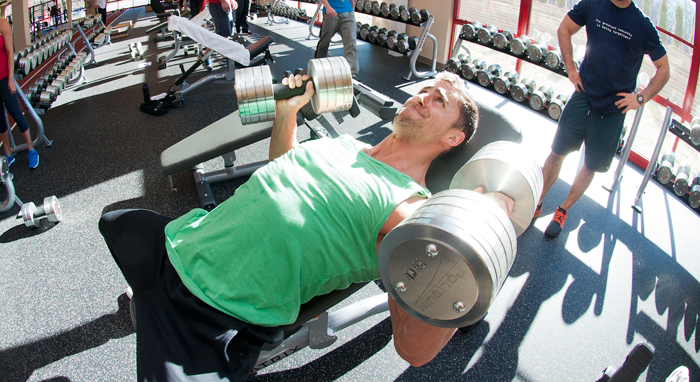
2. Improving dumbbell pressing strength improves barbell pressing strength, but not necessarily vice versa at the same percentage.
Because of the physiological law of specificity, strength is gained only in the range in which it is trained. Dumbbell work, if performed properly, increases strength through a greater range than barbell work. I am not suggesting that you should stay away from barbell exercises, of course, but that if you are pressed for time, dumbbell pressing provides a greater return on your investment than barbells. As a rule of thumb, for fast increases in pressing strength I use dumbbells in the accumulation phases and barbells in the intensification phases.
Dumbbells also offer the advantage of correcting the bi-lateral deficit often seen in trainees.
3. Supine presses have the greatest transfer effect to all presses.
All pressing exercises have some degree of transfer to the other ones. If you concentrated on dips, for example, your overhead presses would increase and vice versa. But all factors being equal, the supine press (i.e., bench press) is the pressing exercise that transfers the most to the other extremities. It is explained by the combination of the amount of weight used, the intermediate motor pattern, and the muscles recruited.
4. All factors being equal, incline presses are the best predictor lift of all presses.
Incline presses have been shown to be the pressing exercise with the least percentage of improvement growth. Interestingly enough, it is also the pressing exercise most related to all throwing patterns.
Let’s make something clear before we go any further. Incline pressing 280 kilos does not guarantee you a gold medal in the shot put at the Olympics, but improving your incline press strongly correlates with improving shot put performance. Thus, if you already have good mechanics in putting the shot or throwing baseballs, concentrating on improving incline presses will do more for your shot put performance than spending hours at the dipping station.
Next, throughout the years, for all lower body sports that require speed, I have found there is an optimal ratio that, when achieved, translates into short-distance improvement. For example, in short-track speedskating, when the incline press reaches 85 percent of the front squat, you get the best potential speed for the 500 meters. Of course, the skater should also work on getting his or her front squat numbers as high as possible.
5. Using accommodating loading devices accelerates progress in pressing exercises.
Presses share this common force pattern: The end portion of the concentric range is much stronger than the start portion. Therefore, using bands and chains allows for a greater overload in the end range which most closely matches the strength curve.
From experience, for every workout using chains, one workout should be done with bands. Using bands every workout tends to results in overused tendons. Very strong athletes often get better results with this progression: