




Blog

Poliquin Live

Tip 405: Dead Lift For a Stronger Back and Tighter Core: Prevent Lower Back Pain

Thursday, August 02, 2012 5:51 AM
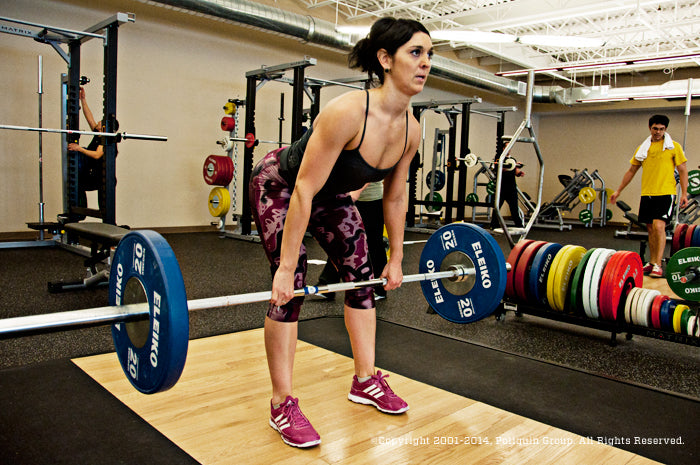
Do dead lifts to build a stronger back and tighter core. In addition to a leaner, stronger mid-section, including dead lifts in your training can help prevent lower back pain. In fact, a new study in the journal Archives of Physical and Medical Rehabilitation found that the dead lift is the MOST effective exercise for strengthening the lower back.

The study compared electromyographic (EMG) muscle activity in the paraspinals (lumbar and thoracic erector spinae) during the following exercises: a dead lift performed at 70 percent of the 1RM, a lunge with 70 percent of the 1RM, a back extension, a single leg bodyweight dead lift, a single leg body weight dead lift on a BOSU, and a static supine bridge on a BOSU.

Results showed that the dead lift was by far the most effective exercise at working the paraspinals. Average EMG activity was 88 percent and peak EMG activity was 113.4 percent for the lower back muscles. The back extension and lunge exercises also provided significant muscle activation, although not nearly as much as the dead lift. The back extension produced average EMG activity of 58 percent, and the lunge produced 46 percent muscle activity. All other exercises produced significantly less muscle activity (29 to 42 percent in the paraspinals), with the supine bridge on the BOSU eliciting the least.

Clearly, the multi-joint lifts with moderate to heavy weights are MUCH more effective than body single-joint body weight exercises. Of course, dead lifts and lunges will also train the entire lower body musculature, making them superior to all other lifts aside from the squat when comparing traditional lifts.

Researchers suggest that regularly training dead lifts with a load ranging from 70 to 85 percent of the 1RM in conjunction with other multi-joint “global” lifts will optimally strengthen the lower back and help prevent lower back pain. With more than 65 million Americans currently suffering from lower back pain, we can see the value of this study for the general population.

But, athletes can benefit just as much: A recent study that looked at injury rates in collegiate male basketball players found that the number one injury was to the lower back and in one case study of a Division 1 team, 5 of 14 players experienced a lower back injury during the season, while no other injuries occurred.

Obviously, a client who comes in with lower back pain or a disc injury will need to perform rehabilitation and achieve structural balance, but this study shows that the dead lift, back extension, and lunge are exercises that should be trained, when appropriate. Individuals without any lower back problems also need to achieve structural balance, but once they do, dead lifts and other global lifts should be training staples.

Reference:
Colado, J., Pablos, C., et al. The Progression of Paraspinal Muscle Recruitment Intensity in Localized and Global Strength Training Exercise is not Based on Instability Alone. Archives of Physical and Medical Rehabilitation. 2011. 92, 1875-1883.
 

Copyright ©2012

Join Our Email List Follow us on Twitter Follow us on Facebook Follow us on YouTube Follow us on Flickr Follow us on Instagram