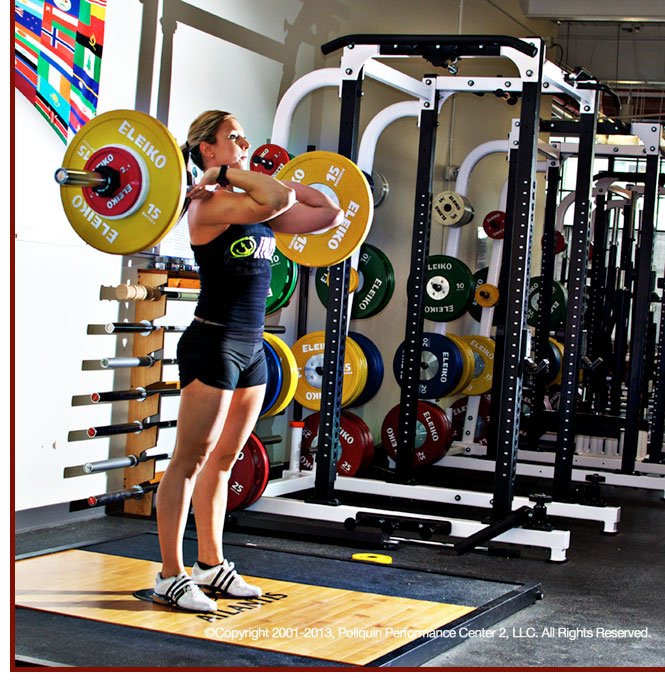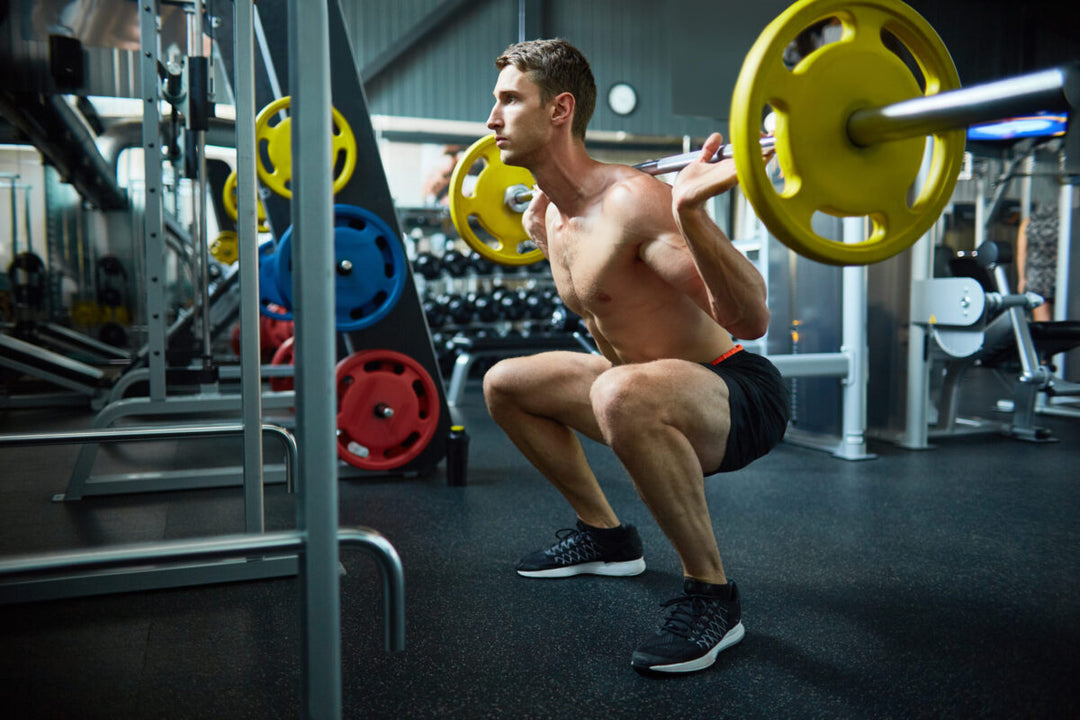




Do front squats to get stronger and improve athletic performance. The front squat is one of your best tools for achieving new levels of athleticism, optimal flexibility, and dyanimic mobility. It’s a great lift for recreational trainees and it translates to sports such as bobsledding, alpine skiing, speed skating, rugby, basketball, and football.
A couple of new studies show how to get the best results from the front squat. First, the front squat requires you to have superior flexibility in the hip, ankle, shoulder, and wrist. If you don’t have the flexibility to perform the front squat, you will never reach your lower body strength potential.
Second, the front squat keeps you technically honest too because if you cheat by shooting the hips back during the upward motion, you may drop the bar. The front squat also places less compressive force on the knee than the back squat, while still providing a comparable training stimulus to the muscles.
Third, electromyographic readings show that the front squat works the quadriceps, rectus abdominis, and erector spinae better than the back squat. This makes it an excellent exercise for the quads and trunk that applies to sprint speed and jumping ability for athletes because it allows you to train the body to transfer force through the kinetic chain. For example, a study of elite Australian rugby players found that the athletes with higher front squat maximum lifts had faster sprint speeds and agility times than those who could lift less weight.
Another benefit of the front squat is that it helps you train vertical acceleration for Olympic lifts and sports that require jumping. For best vertical results, train back and front squats in a periodized program since training both will allow you to maximally train the posterior chain and hit the quads.
Activation of the trunk and lower limb muscles increases significantly with higher loads, making heavy weights a necessary component of any program. Use stable surfaces for front squat training, and in general, opt for the free barbell squat rather than a Smith machine squat. Studies show that muscles of the trunk, quads, and calves are activated by 25 to 50 percent more by using a barbell rather than a Smith machine.
The maximal strength ratio between the full front and back squat can tell you if you are structurally balanced or need devote training time to a specific body part. Your front squat strength should be 85 percent of your back squat 1 RM. A common reason that trainees don’t achieve this ratio is if they don’t go all the way down in either the front or back squat, or if they lack flexibility to complete the lift correctly. Therefore, the front squat can be used as an incentive to work on flexibility and technique.
References
Clark, D., Lambert, M., et al. Muscle Activation in the Loaded Free Barbell Squat: A Brief Review. Journal of Strength and Conditioning Research. 2012. 26(4), 1169-1178.
Matuschek, C., Schmidtbleicher, D. Influence of Squatting Depth on Jumping Performance. Journal of Strength and Conditioning Research. 2012. Published Ahead of Print.
Bird, Stephen and Casey, Sean. Exploring the Front Squat. Strength and Conditioning Journal. February 2012. Published Ahead of Print.
Cissik, John. Coaching the Front Squat. Strength and Conditioning Journal. October 2000. 22(5), 7-12.
Copyright ©2012